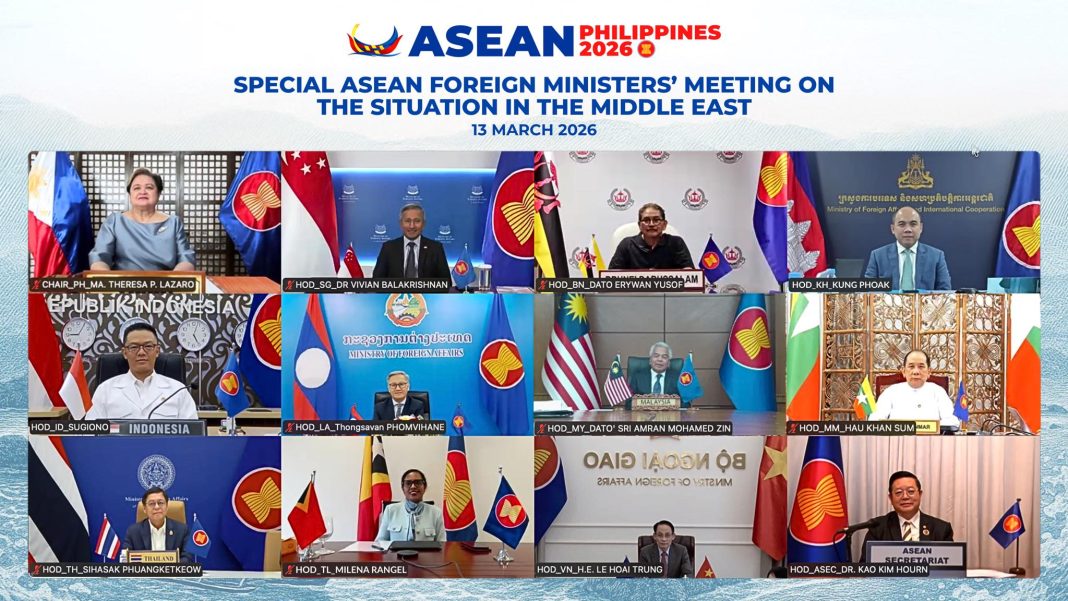

MANILA (March 13, 2026) — ASEAN Foreign Ministers convened an emergency session via videoconference today to address the rapidly deteriorating security situation in the Middle East and its potential fallout for Southeast Asia.
The special meeting was prompted by a significant escalation of hostilities in the region, specifically citing the February 28 attacks by Israel and the United States against Iran, as well as Israeli strikes on Lebanon. In response, a wave of retaliatory attacks by Iran has targeted multiple countries, including Saudi Arabia, Jordan, Iraq, the UAE, and Qatar.
A Call for Diplomacy and Restraint
In a joint statement, the ministers expressed “serious concern” over the violence, noting that the conflict poses a grave threat to civilian lives and global stability. The chair urged all parties involved to:
- Cease hostilities immediately and exercise “utmost self-restraint”.
- Respect international law, including the UN Charter regarding sovereignty and territorial integrity.
- Protect civilian infrastructure and non-combatants in accordance with UN Security Council resolutions.
Protecting ASEAN Nationals
A primary focus of the discussion was the safety of ASEAN citizens currently living or working in the affected conflict zones. The ministers reaffirmed their commitment to the ASEAN Declaration on the Guidelines on Consular Assistance, which ensures that member states provide emergency aid to each other’s nationals during times of crisis. The meeting acknowledged ongoing collaborative efforts to assist those currently in high-risk areas.

Economic and Energy Security
Beyond the immediate humanitarian concerns, ASEAN leaders warned of the conflict’s “spillover effects” on the global economy. The ministers underscored the necessity of protecting:
- Energy Markets: Maintaining stable and open global energy supply chains.
- Trade Routes: Ensuring that maritime and air transport routes remain reliable to prevent disruptions to the flow of food and essential goods.
- Regional Resilience: Utilizing existing frameworks like the ASEAN Power Grid (APG) and the Trans-ASEAN Gas Pipeline (TAGP) to strengthen energy preparedness.
“The Meeting stressed the importance of deeper cooperation… in sustaining ASEAN’s role as a reliable hub for trade, investment, and production networks amid evolving global challenges.”
The session concluded with a pledge to continue monitoring the situation closely and to maintain cross-pillar coordination between political, economic, and socio-cultural bodies to mitigate future shocks.